SwiGLU Intuition
We attribute their success, as all else, to divine benevolence
Activation functions allow neural networks to express non-linear relationships. At a minimum, they must be non-linear and differentiable. For example, the sigmoid function
\[\sigma(x) = \frac{1}{1+e^{-x}} = \frac{e^x}{1+e^x} = 1-\sigma(-x)\]has derivative
\[\sigma'(x) = \frac{e^{-x}}{(1+e^{-x})^2} = \sigma(x)\sigma(-x) = \sigma(x)(1-\sigma(x))\]which has the benefit of being easily calculated if we already know \(\sigma(x)\), e.g. from a forward pass. Over time, this evolved into the simpler \(\text{ReLU}(x) = \max(0, x)\) with gradient \(\text{ReLU}’(x) = H(x)\).
These non-linearities often manifest themselves as sparse encodings within an MLP, where each neuron “activates” based on the presence of a linearly identifiable feature in the input, and uses the magnitude of activation to scale its output vector.
\[f_\alpha(\mathbf{x}) = \overbrace{\alpha(\mathbf{x} \cdot \mathbf{w_i})}^{\text{activation}} \mathbf{w_o}\]For \(\alpha = \text{ReLU}\), if \(\mathbf{x} \cdot \mathbf{w_i} > 0\), then the neuron is activated. Otherwise, the neuron is inactivated.
We can see this at work in a 2-neuron XOR gate.
The first neuron identifies x OR y, the second x AND y, and the output \(z=1\) iff the first neuron is active and the second inactive.
The sparsity introduced by the flat left tail of ReLU is really nice for reverse engineering neural nets, as we can learn to associate certain features with activation and inactivation of individual neurons (see OthelloGPT).
However, this is a double-edged sword: when a neuron is inactive, it has no gradient, and thus doesn’t learn. In order to avoid this, “leaky” variants of ReLU have been proposed, where a small gradient exists for \(x<0\). For example, \(\text{Swish}_\beta(x) = x\sigma(\beta x)\), parameterised by \(\beta \geq 0\), interpolates between \(\text{Swish}_0(x) = x/2\) and \(\text{Swish} _\infty(x) = \text{ReLU}(x)\), with \(\text{SiLU}(x) = \text{Swish}_1(x)\) commonly used.
[interactive beta slider with transparent asymptotes]
As compute availability and task complexity increased, so did the desire for more expressive neurons. GLUs (https://arxiv.org/pdf/1612.08083) introduced flexibility by factorising the feed-forward function into two separable components: an information and a gating variable.
\[g_\alpha(\mathbf{x}) = \overbrace{(\mathbf{x} \cdot \mathbf{w_j})}^{\text{info}} \overbrace{\alpha(\mathbf{x} \cdot \mathbf{w_i})}^{\text{gate}} \mathbf{w_o}\]Several candidate \(\alpha\) functions were trialled and empirically it was decided that \(\alpha = \text{SiLU}\) was the “best” (https://arxiv.org/pdf/2002.05202), which led to the widespread adoption of the so-called corresponding SwiGLU (Swish + GLU) activation.
Unfortunately, I feel that this naming leads to a lack of intuition on why this function performs so well, likely because this wasn’t well understood at the time (the leading quote for this post was lifted verbatim from the SwiGLU paper). Rather than SwiGLU being a GLU with \(\alpha = \text{SiLU}\), I see it as a GLU with \(\alpha = \sigma\) and a bilinear information term \((\mathbf{x} \cdot \mathbf{w_j})(\mathbf{x} \cdot \mathbf{w_i})\).
This is powerful because the bilinear term allows for multiplication between input variables!
[1d x^2 relu vs swiglu]
[2d ellipse]
One thing we must be cautious about is gradient instability due to higher-order terms.
Polynomial order, ReLU^2 (https://arxiv.org/pdf/2402.03804) discussion
Towards biological neuron expression (integrators? dynamical systems? https://www.science.org/doi/10.1126/science.aax6239)
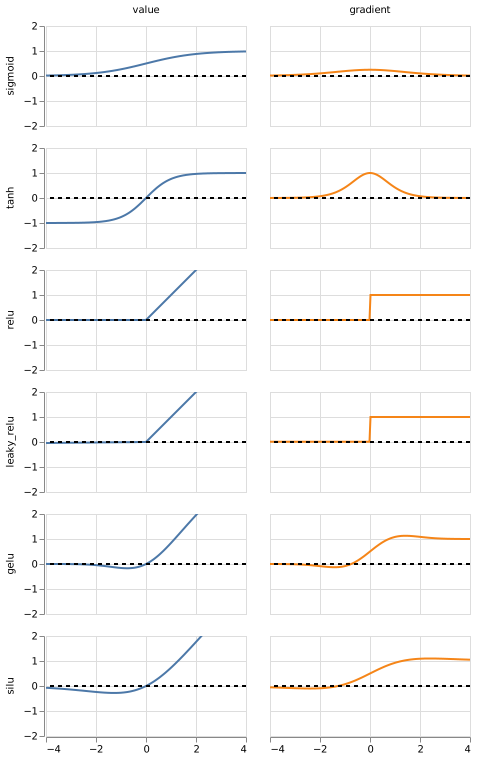
- Key thing is depth = polynomial order?
- Maybe it’s more param efficient to just use higher-order activation functions? \(\beta(x) = x \alpha(x)\), e.g. \(\beta_\text{ReLU} = \alpha_\text{ReLU}^2\)
- ReLU^2 wins https://arxiv.org/pdf/2402.03804 - sparsity is a feature not a bug! Imo sometimes vectors are bidirectional, sometimes not (ray). E.g. “risk-seeking” vector yes, “golden gate bridge” vector no. Maybe it’s a simplex, e.g. theirs/mine/empty in OthelloGPT